
Essential After-Death Checklist
When a parent passes away, the emotions can be heavy—and so can the responsibilities. From notifying family members to handling legal and financial matters, there are many tasks that need attention. This checklist outlines the practical steps to take in the days and weeks that follow, providing clarity during a time that can often feel disorienting.
I’ve provided a free checklist linked in the article below to help guide you through what to do after the death of a parent—the big and small tasks you will need to work through.
Depending on whether your parent has a surviving spouse or not, some of the items on the checklist will require updating information rather than canceling or closing accounts.
Take it one step at a time. You may find that not every step applies to your situation. Use the checklist as a reference to keep track of the many details that need attention as you move through the process.


FIRST STEPS
In the immediate aftermath of a parent’s passing, there are a few critical tasks that must be addressed right away. This section covers the urgent notifications and initial actions that help begin the process of honoring their wishes and managing their affairs.
1) NOTIFY LAW ENFORCEMENT/EMERGENCY SERVICES
This step is generally necessary only if your parent passes at home. If they were in hospice care or in a medical facility, medical personnel will take care of the legal pronouncement of death.
2) DETERMINE DECEASED WISHES FOR BODY
First, check driver’s license or advance directive paperwork to determine if the deceased wished to donate organs or donate their body for medical research. Contact a hospital right away if this is the case.
Second, find out if your parent had expressed specific wishes for burial or cremation.
3) NOTIFY FAMILY AND FRIENDS
Check email and phone contacts. Look for a physical address book as well.
4) CONTACT FUNERAL HOME OR CREMATION COMPANY
Look for any evidence your parent made prepayments to a funeral home. Otherwise, check a few different funeral homes to compare services and prices.
If your parent wished to be cremated, a direct cremation company can be used as an alternative to a funeral home.
5) CONTACT EMPLOYER
If your parent was still working, be sure to notify their employer.
6) OBTAIN LEGAL ASSISTANCE
This may or may not apply to your circumstance. If your parent had a relatively valuable estate, you may wish to engage an estate attorney. Additionally, if there was no trust in place, an attorney specializing in probate may be helpful.
7) CONTACT SOCIAL SECURITY ADMINISTRATION
You should contact the SSA as soon as possible after death. If social security funds are deposited in your parent’s account after death, the SSA will remove that money once they are informed that the individual is deceased.
You can call 1-800-772-1213 to contact SSA and check on survivor benefits, if applicable.
8) FORWARD MAIL
If there is no surviving spouse, contact the U.S. postal service to have mail forwarded to your address. Alternatively, you should plan to check mail frequently to collect bills, statements, and other important correspondence.
9) CONTACT VETERANS ADMINISTRATION
If your parent was a military veteran, be sure to contact the Veterans Administration to determine if they are eligible for any assistance with burial expenses or recognition through memorial items.
FUNERAL OR SERVICE PLANS
Planning a funeral or memorial service involves many personal and logistical decisions. This section guides you through the process of arranging a meaningful tribute, from selecting burial or cremation options to coordinating service details and announcements.
10) CONFIRM BURIAL OR CREMATION DETAILS
Determine if your parent already purchased a burial plot or whether there is space in a family plot. If being cremated, find out if they had specific wishes for the disposal, scattering, or storage of ashes.
11) MAKE FUNERAL SERVICE ARRANGEMENTS
The first step is to decide where and when to hold a funeral or memorial service. Get in touch with close family to make sure they will be able to attend if at all possible.
Then think about whether you will hold a service at a church, the funeral home, at the graveside, or some other private venue.
12) PURCHASE CASKET OR URN
13) CHOOSE CLOTHING FOR BURIAL
Don’t forget to include shoes and undergarments. Additionally, you may consider including jewelry. In the event you will have a viewing of the body, jewelry may be included for that purpose and then removed before burial, if desired.
14) ORDER HEADSTONE
15) DECIDE FUNERAL SERVICE DETAILS
Enlist help in planning the funeral or memorial service. There are a lot of pieces to consider, and having assistance from friends and family is key to easing the burden of organizing an event while you are grieving.
Here is a short list of items to consider when planning the service.
- location
- notification/announcements
- officiant
- readers
- musicians/singers
- pallbearers
- viewing
- music
- readings/prayers/messages
- eulogy
- pictures/slideshow
- program
- obituary
- flowers
- guestbook
- food and decor for funeral reception
IMPORTANT DOCUMENTS
Having access to important documents is essential for managing your parent’s estate. Here, you’ll find a list of key records to locate and organize, along with tips for creating a clear picture of their assets, accounts, and obligations.
16) LOCATE IMPORTANT DOCUMENTS
- will
- trust documents
- tax returns
- insurance policies
- property deeds
- vehicle titles
- login and password information
17) INVENTORY ASSETS & DEBTS
Begin a document listing an inventory of assets and debts. This will be helpful as you go through any probate process or for the estate executor to have clear records.
Assets:
- real estate property
- vehicles
- equipment
- jewelry
- investments
- business interests
- cash
- bank accounts
- art
- collectibles
Debts:
- mortgages
- car loans
- credit card debt
- personal loans
18) LIST BILLS & EXPENSES
Having a list of bills and expenses will make it easier to manage the details of updating or closing accounts.
Read: 30 Days of Praying Scripture


DEATH CERTIFICATE
The death certificate is a vital document required for many legal and financial processes. This section outlines how to obtain certified copies and what information you’ll need to provide when making the request.
19) OBTAIN DEATH CERTFICATE
To obtain the death certificate, check with the funeral director at the funeral home. Alternatively, you may check with your state Department of Health or your state Office of Vital Statistics.
It is advised to request at least 10 copies of the death certificate, as you will need to send this document to financial institutions, insurance providers, utility providers, and other such entities and organizations.
Here is a list of information typically required for a death certificate:
- legal name of deceased (including maiden name, if applicable)
- date of birth
- birthplace (city/state)
- social security number
- residence address
- father & mother’s full names
- marital status and name of surviving spouse, if applicable
- military service, if applicable
- place of death
- cause of death
- date and time of death
- method/place of disposition
- name of funeral facility
FINANCIAL AND LEGAL TASKS
Settling your parent’s financial and legal affairs can take time, but having a checklist makes it more manageable. From initiating probate to closing accounts and notifying agencies, this section breaks down each necessary step.
20) BEGIN PROBATE PROCESS
Ideally, your parent will have designated beneficiaries and drawn up trust documents to avoid the necessity of going through probate, but if not, you should begin the probate process at your city or county court office.
21) MANAGE BANK ACCOUNTS
Check bank statements for automatic deposits or withdrawals. Make a list of companies to contact to stop those that are no longer necessary.
Ensure any outstanding checks that were written clear the account before closing.
Close bank accounts if you are a joint owner or beneficiary (see below).
If accounts are joint, the joint owner has immediate access to funds. If the account has a payable-on-death beneficiary listed, that beneficiary can claim the funds upon presentation of the death certificate. Otherwise, the funds will be managed by the executor of the estate.
22) CONTACT CREDIT AGENCIES
Pull a credit report—this can help in knowing who to notify of your parent’s passing. Additionally, notify at least one of the three major credit bureaus of your parent’s death. This will help prevent identify theft.
23) CANCEL CREDIT CARDS
Again, this is an important step in preventing identity theft. Do this as soon as possible after your parent’s death.
If your parent has a surviving spouse who is also a user on the cards, notify the credit card company of your parent’s passing so that their name can be removed to help prevent identity theft.
24) TRANSFER TITLES
If your parent had a will, the executor of the estate will be responsible for transferring titles as expressed in the will.
Otherwise, the probate court will determine who inherits the property and those individuals will be responsible for transferring title to vehicles and property.
25) NOTIFY LENDERS
Contact mortgage companies, vehicle lenders, or any other loan holders.
26) NOTIFY FINANCIAL INSTITUTIONS
Contact banks, credit unions, brokerage firms, or investment companies.
27) NOTIFY INSURANCE PROVIDERS
Contact any insurance policy providers: life insurance, private health insurance, homeowners insurance, auto insurance.
If your parent was on Medicare, once you contact the Social Security Administration, they will notify Medicare of your parent’s death.
Don’t forget about supplemental Medicare insurance plans, long-term care insurance, travel insurance, or pet insurance.
28) NOTIFY UTILITY PROVIDERS
You should contact each utility provider—electric, gas, water, sewer—to notify them of your parent’s passing. They will have a process for closing or transferring the accounts.
29) CONTACT MONTHLY SERVICE PROVIDERS
Check credit card and bank statements to find monthly service providers—call to cancel services and close accounts.
- streaming services
- phone
- internet
- gyms or clubs
- monthly subscription services (meals, cheese-of-the-month club, etc.)
- home security service
- lawn care service
30) LOOK FOR RECURRING MEMBERSHIPS
Look back through the previous year’s bank and credit card statement to find recurring membership charges that occur less frequently.
- club store memberships (Costco, Sam’s Club, etc.)
- Amazon, Walmart, or other online shopping memberships
- magazine subscriptions
- technology service (e.g. Geek Squad)
31) CONTACT DMV
Visit your state Department of Motor Vehicles to cancel your parent’s driver’s license and request that records be removed to prevent identiy theft.
32) UPDATE VOTER REGISTRATION
Contact your local election office to cancel your deceased parent’s voter registration.
33) CONTACT FREQUENT FLYER AND LOYALTY PROGRAMS
Most airlines do not allow for transferring frequent flyer miles, but there are some exceptions to that rule. Contact the airlines to close the account and ask about the possibility of transferring miles or points.
If your parent participated in frequent buyer programs with hotels, credit cards, or other companies, contact the company directly to determine if those rewards can be transferred to the legal beneficiary.
34) DELETE OR MEMORIALIZE SOCIAL MEDIA ACCOUNTS
Decide if you wish to memorialize your parent’s social media accounts. Not all platforms offer this option, but Facebook and Instagram do at this time.
Contact the individual platforms to memorialize or close any accounts your parent had.
35) MONITOR MESSAGES
Until you cancel and close your parent’s phone and email accounts, make sure to regularly check and monitor email accounts, text message, and voicemails.
Don’t rush to close email accounts, as you may be alerted to important information through emails that will help you deal with all the details of canceling and closing accounts. After you feel confident that you have wrapped up all the loose ends, you can shut down and close the email accounts.
36) FILE TAX RETURN
Depending on the complexity of your parent’s estate, you may need to enlist the assistance of a CPA specializing in tax. In any case, a final tax return must be filed with the indication that the person has died.
Visit the IRS page detailing how to file a final tax return for helpful information.
HOME MANAGEMENT TASKS
Your parent’s home will likely require attention and care in the weeks that follow. This section includes practical reminders for securing the property, managing household needs, and preparing for the eventual distribution of personal belongings.
37) SECURE PROPERTY
Make sure home and vehicles are locked and secured.
38) GARBAGE REMOVAL
Remove garbage from the home and find out the day/time of regular garbage service. You may wish to maintain trash service while you work on cleaning out the home.
39) ARRANGE PET CARE
If your parent had a pet, you’ll need to arrange for care or find an appropriate rehoming situation for them.
You may want to contact your parent’s veterinary office for help if you need to rehome the animal.
40) RETRIEVE KEYS
Get keys for home and vehicle if you are responsible for caring for them. Look for spare house keys outside and consider who might have been given spare keys as well.
41) FIND ALARM CODES
If your parent had an alarm system installed and you do not know the codes, you’ll need to contact the alarm company.
42) LOCATE FUSE BOX AND WATER SHUTOFF
In case of emergency, familiarize yourself with where the location of fuse boxes and water shutoff valves.
43) ARRANGE LAWN CARE
Depending on whether your parent had an arrangement in place or not, you’ll need to plan for maintaining the lawn and outdoor property.
44) FIND STORAGE FACILITY INFORMATION
Determine whether your parent had any storage facilities and how to access the facilities.
45) PLAN FOR DISPOSAL OF PERSONAL POSSESSIONS
Depending on what your parent outlined in their will, some personal possessions may be specifically earmarked for a particular person.
However, there will likely be a significant amount of personal property that will need to be disposed of in addition to those specific items.
Once you’ve gotten through the urgent needs of financial matters and the funeral service, you can begin to think about how to handle your parent’s possessions.
Make a plan for having an estate sale, giving items to family and friends, or other disposal of their household and personal items.
Allow plenty of time for this process if you have the luxury of not being under an imminent deadline to clear things out.

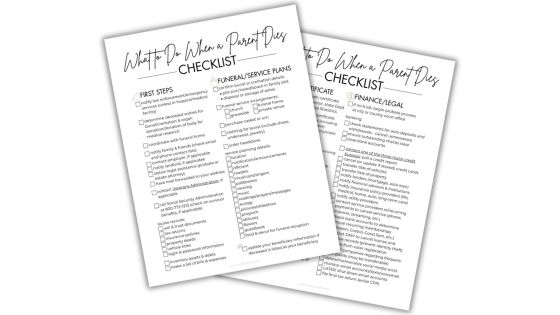
Step by Step Plan for When a Parent Passes
One final item to remember is to change beneficiary information if your deceased parent is designated as a beneficiary on any of your accounts. You’ll want to update that information and change the listed beneficiaries.
The many checklist items mentioned above will take time. While no checklist can ease the grief of losing a parent, having a clear list of what needs to be done can offer a small sense of stability during a deeply emotional time. Take each step at your own pace, ask for help when you need it, and know that it’s okay to grieve as you go.
Visit my homeschool resources page for monthly unit study ideas, projects, and homeschool planning help!


You May Also Like…



What to Do When a Parent Passes: Free Checklist

